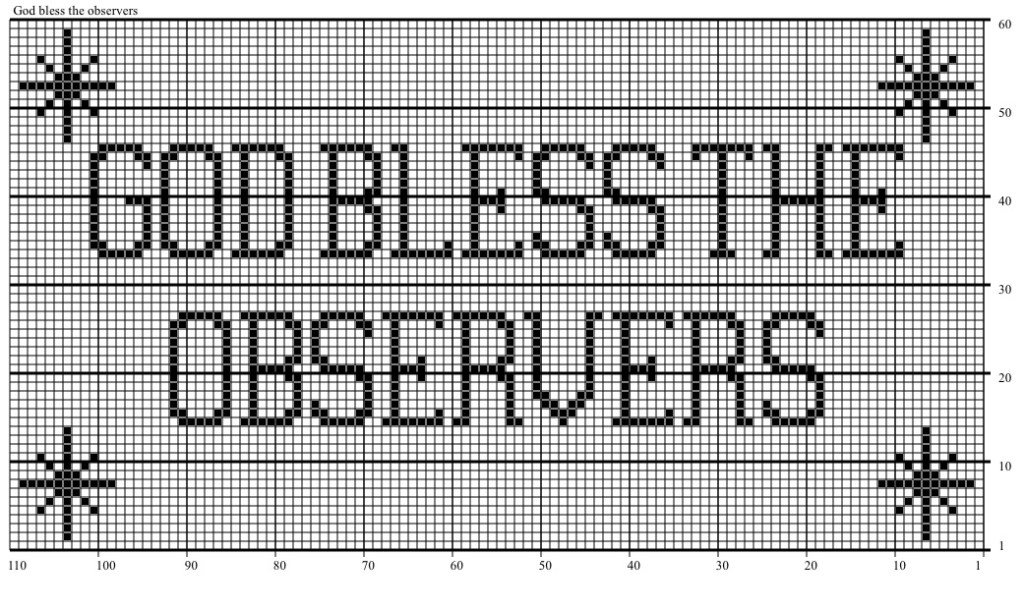
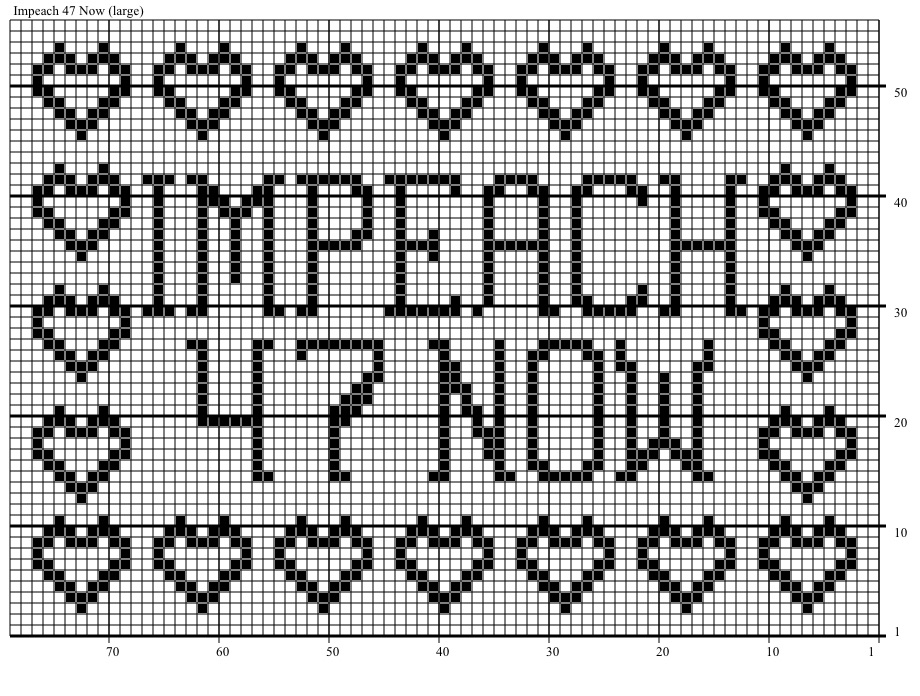
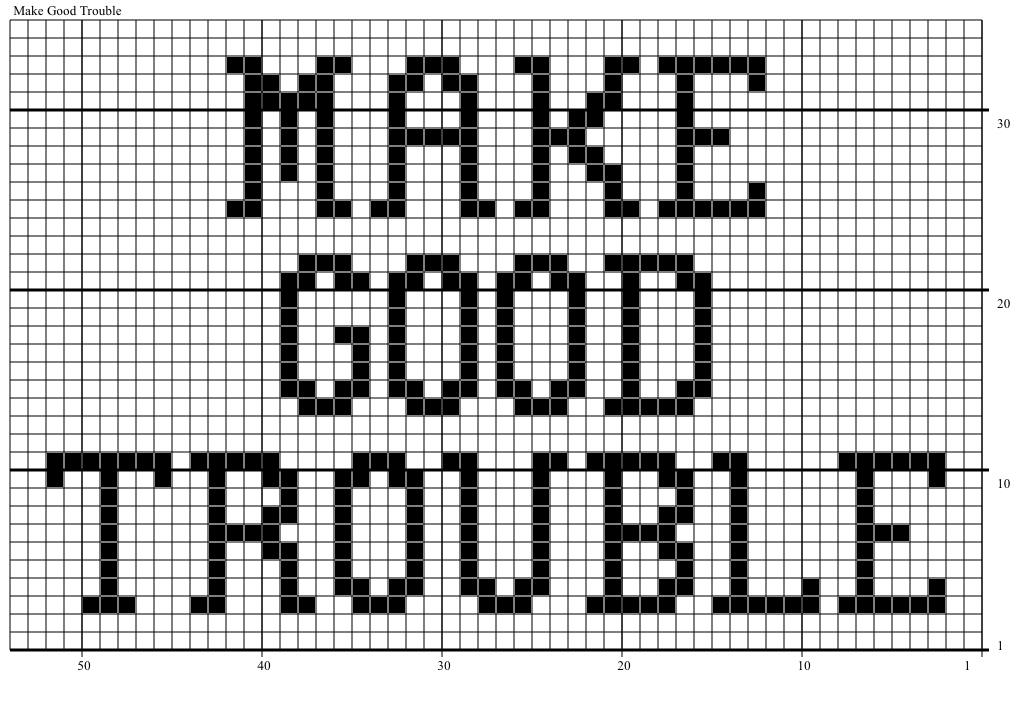
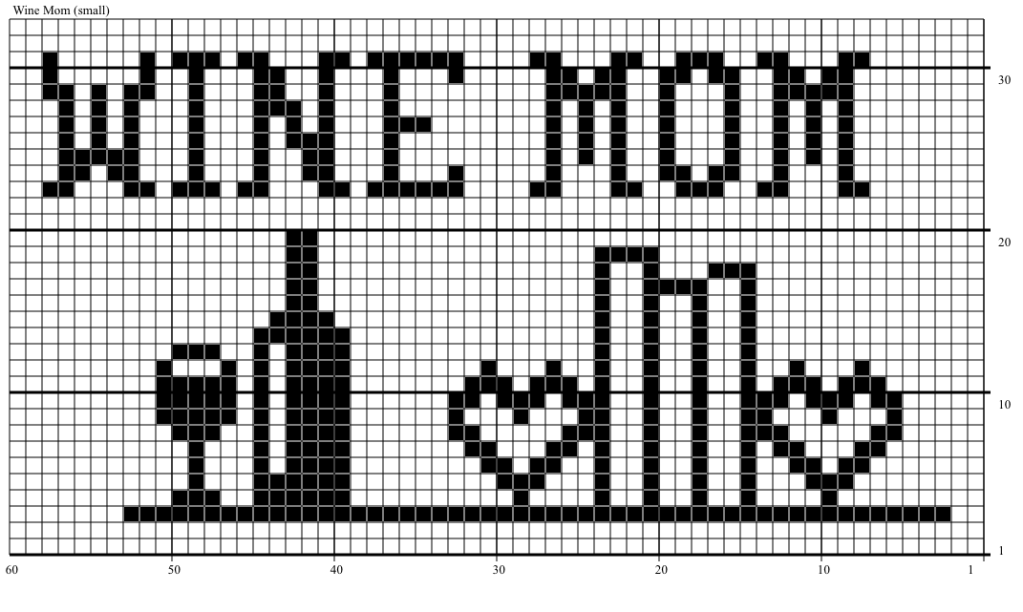
Needlework has a long history of offering an outlet of political statement and protest. This section of my website is dedicated to protest in crochet form, beginning with statements in filet crochet.
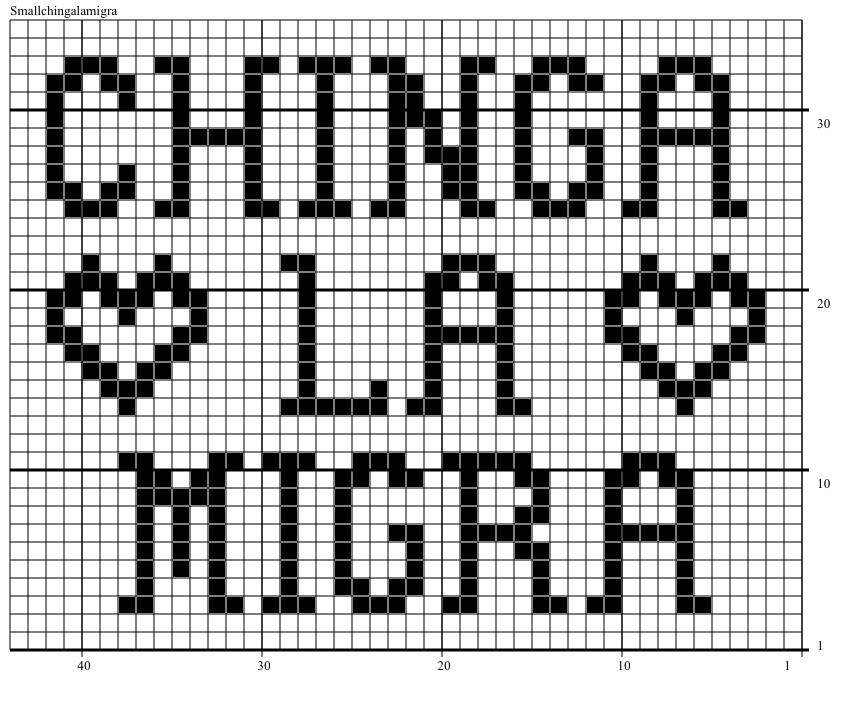
I chose filet crochet not only because it lends itself so easily to textual representation, but because there is something so powerful about using the finest of threads, smallest hooks, and the most delicate and traditional crochet form to communicate strength and opposition. A framed tapestry could end fascism. A delicate doily could take down a dictatorship.
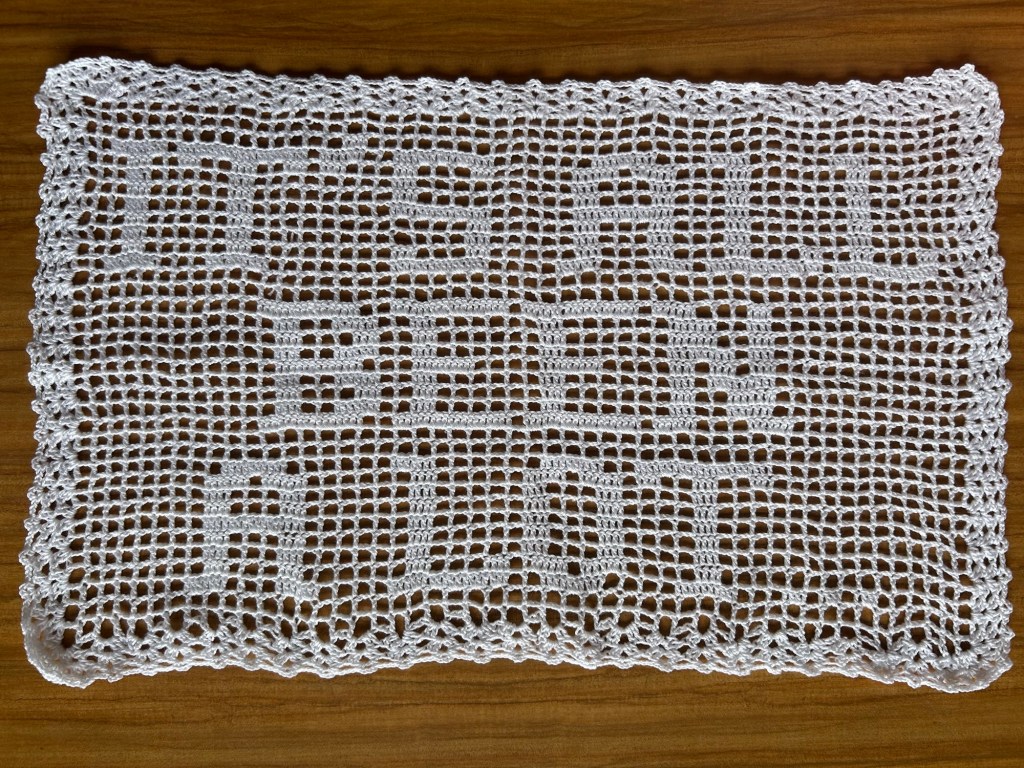
To give you an idea of what filet crochet looks like, here is a project I made for a friend (you’ll notice the tension isn’t right on that starting ch. It’s a struggle):
Many of the statements on the designs were pulled from common protest slogans in the wake of the murder of Renee Good in Minneapolis, some were submitted to me by followers, others, come with longer roots, like quotations from Martin Luther King, Jr.
I aim to offer these in two sizes: one with smaller text and one a bit bigger. Let me know if you have some suggested text or if you would like me to work on a different size more urgnetly.
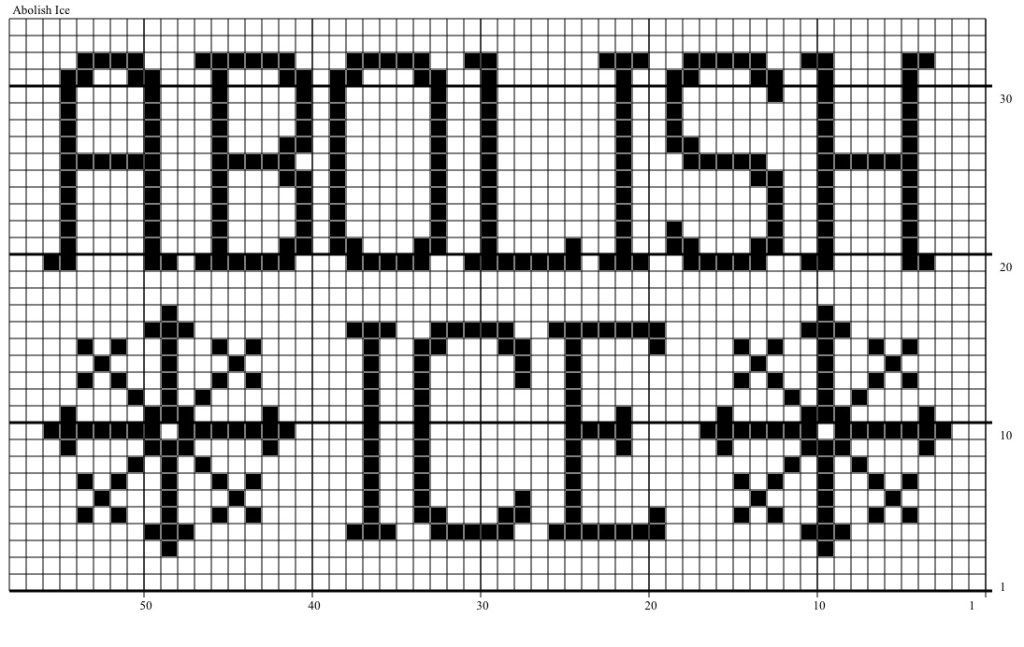
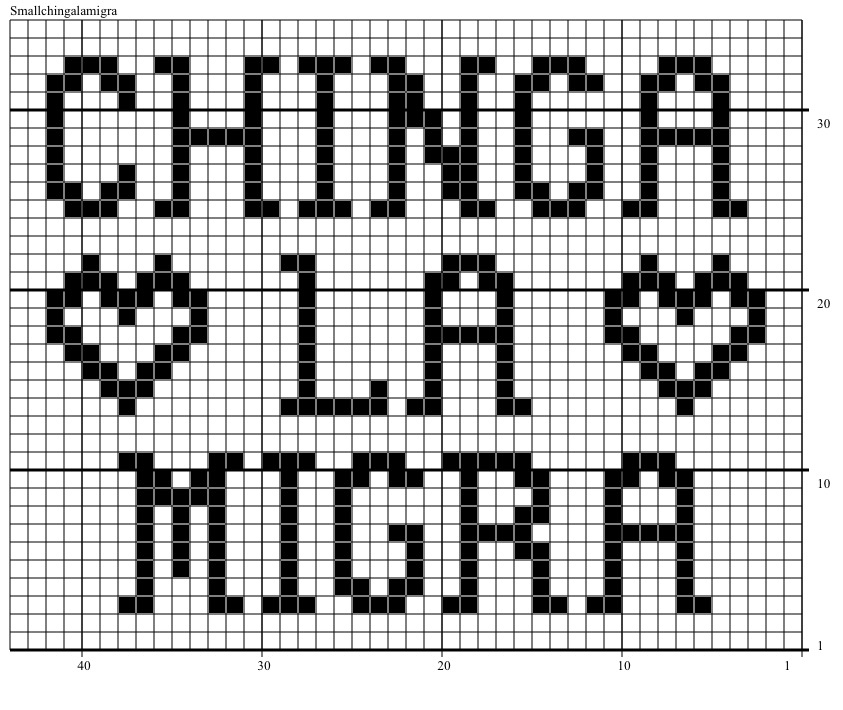
Some general filet crochet instructions: Filet crochet usually relies on a design plotted over a graph, worked in rows (but there is filet worked in the round as well), beginning from the bottom and working your way up. You follow the graph by zig zagging across; so, the first row, you read left to right, but the next, you read right to left, continuing to alternate your way up from the bottom.
You begin with a starting ch (at the bottom). Calculate the number of ch you need for your starting ch by multiplying the number of boxes across you need by three and adding one. At the end of your starting ch, you need to add 3 ch for the side of the first box and 2 ch for the top (so add 5 more ch total), then work your first dc in the ninth ch from your hook. Then, every blank square is worked as (ch 2, sk 2 ch, dc in next) across the starting ch. On subsequent rows, you ch 5 at the start (again, this is the side and top of the first box), then every blank square is worked either as (ch 2, sk 2 st, dc in next) or as (ch 2, sk ch-2 sp, dc in next st), depending on whether the square bellow was filled or empty. Each filled square is worked as (dc in next 3 st). In this way, the blank squares form a mesh and the filled in squares become the solid parts of the design. No matter what, whether a filled or blank square, each square takes up 3 spaces. Once you have completed the pattern, row by row, from the bottom up, you can add some pretty edging. Simple! The only really hard bit is not losing count as you go along and getting the tension right on that starting ch.
Now, some apologies: these will not have all run through testing (not even by myself). My hope, here, is to get these to you fast. So, in effect, you are a tester (please let me know of any modifications that you think are needed). I will put at the top of the pattern “Not yet tested” or “tested” to let you know which have already been tried out. Only patterns that I myself have tested out will have a border. For all others, I suggest digging through the amazing resource that is Free Vintage Crochet for their encyclopedia of filet edging. I don’t usually cut corners like this, but my priority here is to get these to you fast.
And now, some disclosures: I usually chart my filet crochet patterns out on actual, physical graph paper, but that is when I am just making a pattern for my own use. I don’t know how to transfer a design like that easily from paper to pdf, so to get these out there quickly and in a format that might be broadly readable, I am relying on an app for help. The app is called FCCreator, is very easy to use, and is not horribly costly. You can totally do this yourself! There is an option to turn the graph into written instructions, and I am considering adding those to the graph. As far as I can tell, that process is automated, but not AI. But even if I do rely on the written instructions the app has generated, it will be withmodifications (for example, I tend to work with 10 cotton, but the app only gives measurements for 20 cotton, so I will offer some extra information on which hook size or gauge you can expect with 10 thread as well). For the lettering, I tend to use the models offered in the book Say it in Filet: 6 Thread Crochet Designs by Betty Phipps. I do modify them at times.
Further disclosure: I do run ads on my site. The site is expensive and time consuming to maintain and so far, despite spending hundreds of dollars and dozens of hours I have spent maintaining it, I have only made 28 cents off of ad revenue and have never sold a pdf pattern. While I would love to turn a profit, I am not yet anywhere near doing so, so, yes, I will continue to run ads, even on these resistance patterns. I do not intend to turn these into pdf patterrns as I usually do with my patterns, strictly because it takes a lot of time to do so, and, again, I am hoping to get these to you quickly. And finally, as you may have noted, while I was born and raised there, I do not currently live in the US. This is my way of doing a very very little part from afar. If you want to support my work, there is a little button at the top that offers the possiblity of paying for the costs of the site.
Now, enjoy! Filet crochet is easy to do and a lot of fun.

 Five Stitches Crochet